Life After C-Band: Satellite-Hybrid Delivery with RIST
How VSF TR-06-4 Part 7 keeps satellite as the primary path and uses RIST over the internet to recover what the space segment loses.
VSF TR-06-4 Part 7 defines an interoperable satellite-hybrid model: satellite stays the primary path, and RIST over the internet recovers only the packets lost in transit, without prohibitive investment in managed networks.
The FCC has adopted its plan for the upper C-band auction (slated for July 2027), clearing 160 MHz (3.98 to 4.14 GHz), short of the 180 MHz it originally proposed, but well above the 100 MHz floor Congress mandated and the 100 MHz cap broadcasters had lobbied for. Broadcasters reliant on this spectrum now have to re-plan distribution around this effective elimination of C-band broadcasting.
The problem space is now Ku-band transmission and IP delivery, and each poses its own challenge to reliable video transport. Ku-band’s shorter wavelength is more susceptible to rain fade than C-band. IP over unmanaged portions of the internet is unpredictable in nature, and more so in the markets where high-quality links are scarce.
The economics also change. A fixed-price transponder lease served many receivers at once; IP delivery is priced per connection. A national footprint that was a known line item becomes a variable one that scales with the number of endpoints. The challenge now facing broadcasters and their distribution partners is pivoting a nationwide C-band footprint to new infrastructure without giving up the reliability and cost predictability that have defined their operations for decades.
TR-06-4 Part 7
The Reliable Internet Stream Transport (RIST) Activity Group in the Video Services Forum (VSF) published its technical recommendation VSF TR-06-4 Part 7, which outlines the “Satellite-Hybrid” workflow in anticipation of what has since become a certainty. It defines an interoperable resiliency method that keeps satellite as the primary transmission path while using RIST over the internet to recover data that is corrupted or lost in transit.
The result is a viable path to Ku-band transmission, with its shortfalls backstopped by IP without prohibitive investment in managed networks. Since recovery is limited to targeted packet blocks, the internet path carries a fraction of the stream’s bitrate, and only carries the full feed in complete failure events, keeping bandwidth use minimal even across a large receiver population.
The internet path carries a fraction of the stream’s bitrate, and only carries the full feed in complete failure events.
Because the recommendation defines each role separately, every function can be implemented as its own module, and any vendor’s inserter, recovery server, or receiver that implements it can take part. For existing receivers in particular, a software update opens a path to in-place implementation rather than full equipment replacement.
How it works
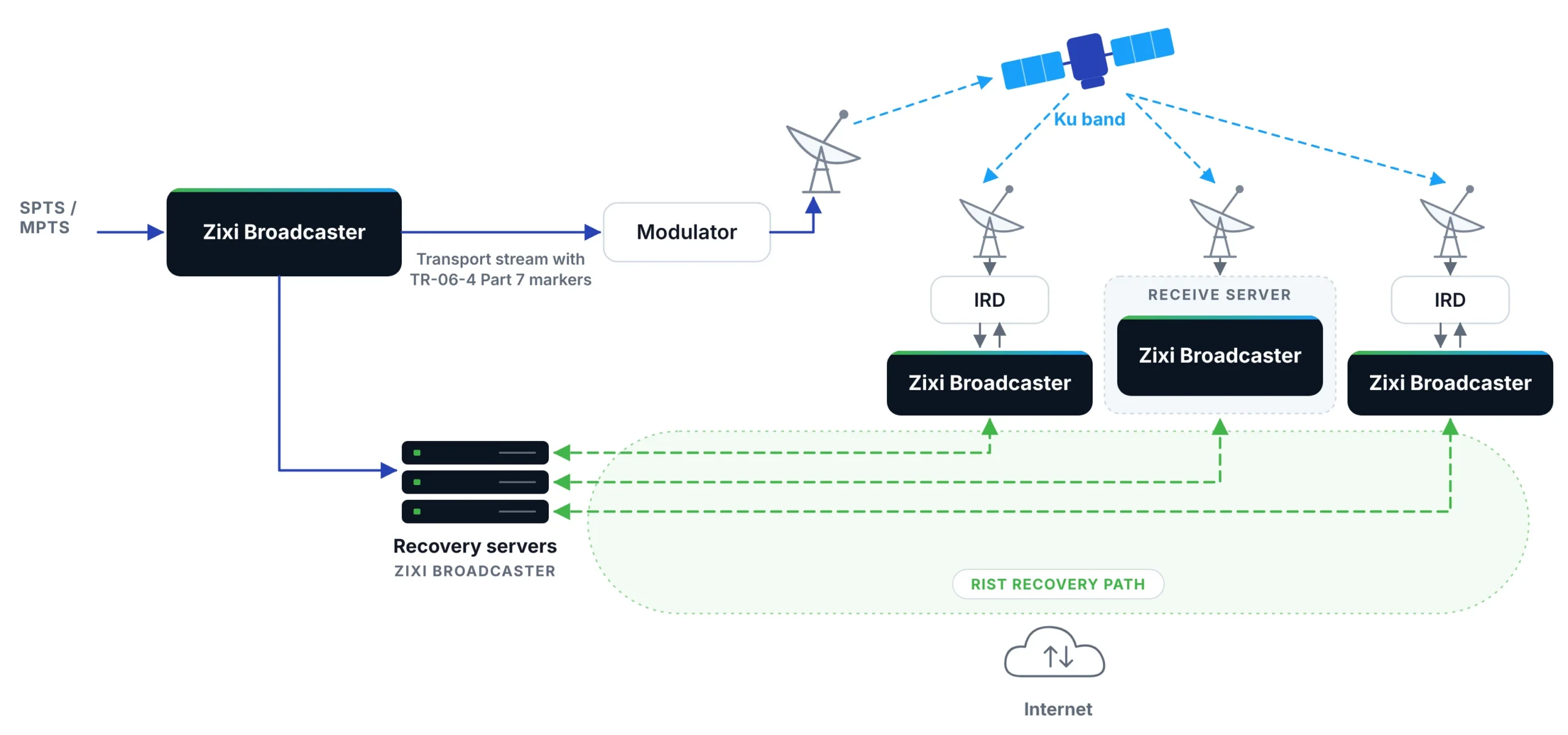
Zixi Broadcaster deploys each function of the recommendation as its own module. Broadcaster splits the sender role into two units: a metadata inserter and a recovery server. The metadata inserter inserts recovery metadata into the null packets of an ingested transport stream, then passes the stream to the satellite uplink. That metadata tracks the number of non-null packets in each transmitted block, which lets a downlinked receiver determine whether critical packets are missing.
The receiver then sends targeted retransmission requests for that block of packets over an IP connection to a Broadcaster recovery server via RIST protocol. Each recovery server buffers the stream, ready to fulfil retransmission requests. Because every recovery server is identical, operators can deploy as many as they need, so a single metadata inserter can support recovery for a nationwide population of receivers.
Any compliant receiver can connect to the recovery servers and parse the recovery metadata, perhaps even a receive device with Broadcaster integration. However, Broadcaster can also be deployed on the receive side to provide IP recovery for legacy or non-integrated devices. The demodulated transport stream is passed to Broadcaster, which repairs it over the established RIST session and hands the recovered stream to any IP-enabled IRD or receiver.
Any compliant receiver can also request a full switch to RIST delivery in the event of a full outage, covering both ends of the range from brief degradation to complete loss of the space segment. Because the recovery is defined by the recommendation rather than by any one vendor, any piece of Zixi’s implementation works with any compliant metadata inserter, recovery server, and downstream receiver, allowing for wide interoperability.
Proving it on the show floor
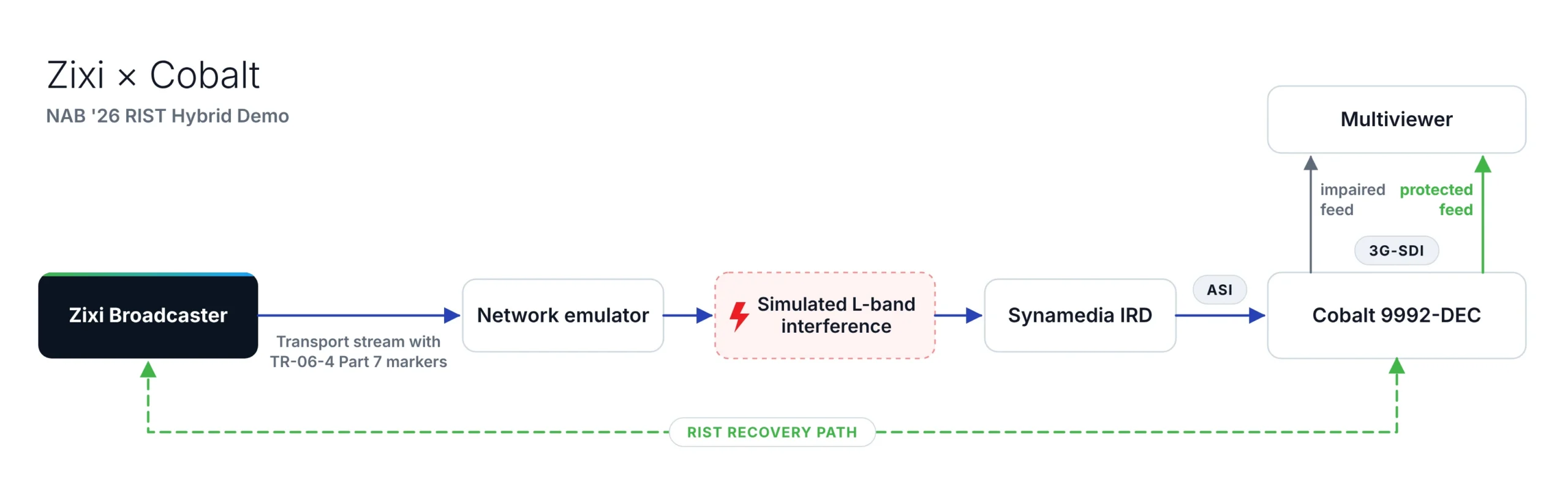
The Activity Group brings together engineers and experts from across the industry, Zixi included, in the spirit of interoperability and best practice. Since the release of the recommendation, Zixi and Cobalt have put that interoperability to the test, demonstrating TR-06-4 Part 7 workflows at several trade shows, including NAB New York, NAB Show Las Vegas, and VSF’s own VidTrans, with show-floor demonstrations pairing Zixi Broadcaster’s send processing and recovery server with Cobalt’s 9992-DEC.
What comes next
Work continues in the Activity Group. The recommendations are available in full on the VSF website. Zixi is also implementing TR-06-4 Part 6 on both the transmit and receive sides of Broadcaster, which adds program selection to recovery of multi-program transport streams, so each receive site pulls recovery traffic only for the programs it actually needs, reducing overall recovery traffic.
Zixi is also exploring Part 8, which extends the approach to an “out-of-band” method that does not require metadata insertion. Zixi will keep contributing to the work and building against the standard as broadcasters and distributors move through the C-band transition. As the landscape shifts, the industry will move with it, and viewers will never know the difference.
Go deeper
Further reading from Zixi
C-Band Is Forcing a Hard Question: Who Controls Live Video in an IP-First World?
Why the C-band transition is an architectural decision, and what it takes to preserve control when the infrastructure no longer provides it.
Read the articleThe C-Band Transition
Own your live video through the C-band transition, and after it. Hybrid or all-IP, with reliability, rights, and switching held constant.
Explore the solutionZixi Broadcaster v19: Keep the Feed on Air, With Fewer Boxes in the Path
Three new and three expanded Broadcaster capabilities built to keep the feed on air when conditions degrade.
Read the article